
I've been on both sides of UDL

May 26, 2026
Somewhere along the way, Universal Design for Learning got reduced to a feature list. Add captions. Add alt text. Make sure the buttons are big enough. Check, check, check. And then we call the course accessible and move on.
That's not UDL. That's compliance with extra steps.
What UDL actually is

Universal Design for Learning is a way of thinking about who you're designing for before you make a single design decision. It's the question you ask before you pick the interaction, before you write the script, before you choose the color palette. It's not what you add at the end. It's the lens you look through from the start.
The framework was developed by CAST, a nonprofit research organization, and is organized around three principles: provide multiple means of engagement, representation, and action and expression. The most recent version, UDL Guidelines 3.0, was released in 2024 and expanded the framework to address barriers rooted in bias and exclusion, not just disability.
But the principles aren't the point. The point is the assumption underneath them: that learners are different, that variability is predictable rather than the exception, and that the smartest move is to design for that reality from the very first decision. As CAST puts it, there is no average brain — and there never was.
Captions are an output of UDL thinking. They're not the thinking itself.
What checkbox UDL looks like

You've seen it. Captions added at the end, auto-generated, never reviewed for accuracy, styled in a way that's hard to read. Alt text that just says "image." A "transcript available on request" link buried in the footer where almost no one will find it. A skip button on the audio that exists because someone flagged it in QA, not because anyone asked who might need to skip and why.
These features look like accessibility on a spec sheet. They function more like a defense — we did the thing, no one can fault us. But none of them started from the learner. They started from the checklist.
Why I'm so loud about this
I have to be honest about where this comes from for me, because the conviction isn't theoretical.
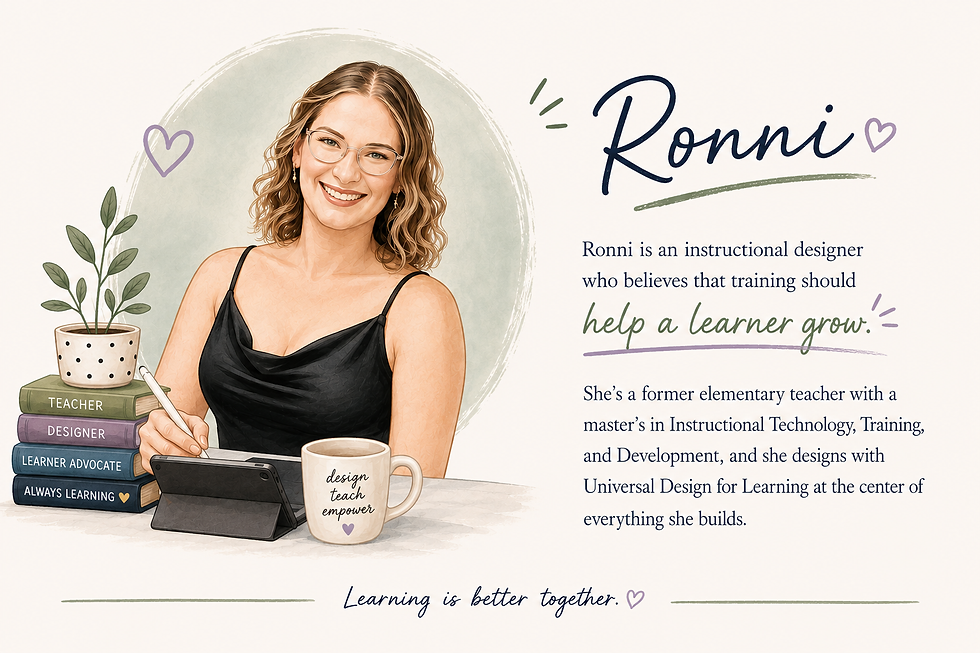
I went through my entire childhood and undergrad career wondering why school was so hard. I got good grades, but I had to try really hard for them. Harder than it seemed like other people were trying. I didn't have a diagnosis, I didn't have a 504, and I didn't have anyone telling me there was a reason for any of it. I just thought that was what learning was supposed to feel like.
Later, when I became an elementary teacher, I learned about accommodations — but only the students who had IEPs or formal documentation got them. I knew that wasn't right. I knew there were kids in my classroom struggling the way I had struggled, who weren't going to raise their hand, who weren't going to be diagnosed, who weren't going to get a plan. So I started building accommodations in for everyone. My PowerPoints, my worksheets, my tests — I redesigned all of it on the assumption that any kid in the room might need what I was providing.

I didn't know there was a name for what I was doing.
Then I started my master's at the University of North Florida, and in my very first semester I took a course on UDL practices in training, taught by the director of my program. I sat in that class and realized I'd been practicing UDL for years without a vocabulary for it. Everything I had pieced together as a teacher, trying to reach every kid in front of me, had a framework behind it. I wasn't making it up. I was doing the work.
What made it land even harder was that the program itself was designed through a UDL lens. I never took a single exam in my entire master's. Every course was project-based. Every assessment had multiple ways to demonstrate what you'd learned. And for the first time in my academic life, I wasn't grinding. I was thriving. I graduated with a 4.0 — not because I suddenly got smarter, but because the program was designed in a way that let me show what I knew.
That's why I'm passionate about UDL. Not because it's a principle I learned in a textbook. Because I've been on both sides of it. I've been the learner who couldn't access the design, and I've been the learner who finally could. The difference is enormous, and it's the difference I'm trying to build into every course I make.
What this asks of us
If you design training, the next time you sit down with a brief, don't start with the feature list. Start with the lens. Ask who you're designing for. Ask what they'll actually need. Ask what would make this work for as many of them as possible, including the ones who won't tell you they need it.
The captions will follow. So will everything else.

References
CAST. (2024). UDL Guidelines version 3.0. https://udlguidelines.cast.org/
CAST. About Universal Design for Learning. https://www.cast.org/what-we-do/universal-design-for-learning/
CAST. Research Evidence for UDL. https://udlguidelines.cast.org/more/research-evidence/
Comments