

Audience
Newly hired travel advisors completing onboarding training prior to handling live client inquiry calls. These learners have foundational knowledge but limited experience applying structured communication in real-time conversations.
My Role
I designed and developed this end-to-end learning experience, including needs analysis, research integration, storyboarding, visual design, and development of interactive scenario-based practice aligned to workplace performance outcomes.
Tools Used
This project was developed using Articulate Rise for course design and Articulate Storyline for interactive scenarios, supported by Synthesia for mentor videos, Canva for visual design, Google Forms for reflection activities, and ChatGPT/Google Flow Labs for content development.
The Problem
New travel agents often enter client-facing roles without structured practice in leading inquiry calls. This results in inconsistent needs assessment, incomplete booking details, and frequent follow-up calls, ultimately impacting client experience and booking outcomes.
The Solution
Booking Brilliance is a scenario-based eLearning experience designed to help advisors confidently guide client inquiry calls. The course provides structured practice, real-time decision-making opportunities, and clear frameworks that support consistent, high-quality client interactions.
Laying the Foundation
The Booking Brilliance project began with a clear performance goal:
Travel agents will make three effective client call decisions that result in 80%+ client satisfaction and revenue.
From there, I focused on analyzing what actions agents must take to reach that goal — and what barriers might prevent them. As both the Instructional Designer and Subject Matter Expert, I drew from my real experience as a travel agent to identify authentic client scenarios and common challenges, such as jumping into recommendations too early or hesitating to introduce value-added options.
To strengthen this foundation, I conducted a formal needs analysis within the context of onboarding at Horizon Path Travel Group. While new agents completed foundational training, performance data revealed a consistent gap between knowledge and real-time application. Over half of new agents were not consistently confirming client-provided information, and nearly half of initial calls ended without all required booking details. This often led to follow-up calls, delayed bookings, and inconsistent client experiences.
These insights made it clear that the problem was not a lack of knowledge, but a lack of structured practice in applying that knowledge during live client conversations.
Based on this analysis, I designed Booking Brilliance to focus on one key outcome: helping agents confidently lead structured inquiry calls that gather complete information, reduce uncertainty, and move clients toward booking readiness on the first call.
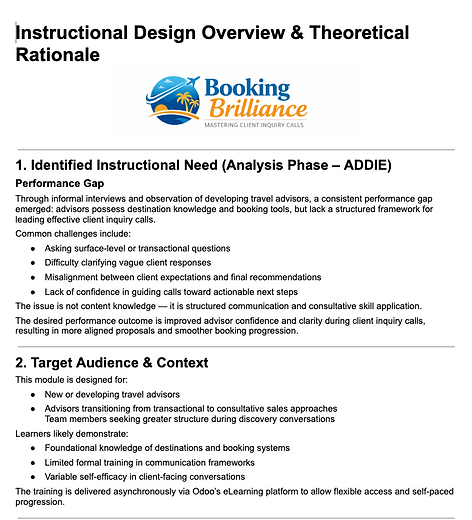

Designing the Learner Experience: Storyboarding the Scenario
I approached the design of this course by first mapping out the full learner journey skeleton directly within Articulate Rise. I outlined the content for each module and section through text, then intentionally refined each part to move beyond text and create a more engaging, interactive experience.


My design decisions were guided by my research on how Universal Design for Learning (UDL) can support accessibility and engagement in corporate eLearning. I focused on creating a course that felt clear, supportive, and easy to navigate while still challenging learners to think and apply their skills.
To create a consistent and guided experience, I introduced a mentor figure who appears throughout the course. This mentor helps frame each concept, connect ideas, and guide learners through the call process, making the experience feel more conversational and less like traditional training.
I was also very intentional about keeping key information concise. Rather than overwhelming learners with content, I focused on what they actually need in the moment and designed each section to support decision-making during a call. Multiple forms of representation were incorporated throughout the course, including visuals, audio, and interactive elements, allowing learners to engage with the material in different ways.
From the very beginning, learners are placed into a realistic client call scenario where they are unsure how to move forward. This creates an immediate connection to the problem and sets the stage for learning. As the course progresses, learners revisit this scenario multiple times, practicing how to guide the conversation, ask better questions, and make more effective decisions.
Reflection is also built into the experience, giving learners opportunities to connect the content to their own experiences and think about how they would handle similar situations in real client interactions.
The course builds toward a final scenario-based assessment where learners complete a full simulated call with a new client and a different set of needs. This allows them to apply everything they have learned in a realistic, performance-based context.
By the end of the experience, learners have practiced the full call process and earned the Client Whisperer badge, reinforcing their progress and celebrating their ability to confidently guide a client conversation from start to finish.
Visual Mockup & Design Systems

I created a cohesive visual system to support clarity, consistency, and engagement throughout the course. Clean layouts, a simple color palette, and bold, readable typography were used to reduce cognitive load and help learners focus on key decisions.
This approach was informed by Universal Design for Learning (UDL), using visuals, structure, and multiple formats to support different ways of understanding.
To enhance realism, I used Google Flow Labs to create short client call video frames that simulate authentic conversations. Combined with a mentor presence throughout the course, these elements help create a more guided, human-centered learning experience.
Developing the Experience
The course was developed as a performance-based learning experience focused on real-world application. Rather than presenting information, I built interactions that require learners to make decisions, evaluate options, and practice guiding a client conversation.
Using Articulate Rise and Storyline, I created scenario-based interactions that mirror real client calls. Learners engage in decision points throughout the course and then complete a full simulated call at the end, applying everything they’ve learned in a new situation.
Interactions were intentionally designed to move beyond simple knowledge checks. Activities focus on skills like prioritizing information, refining responses, and making strategic decisions in context.
The final experience supports learners in building confidence and consistency, preparing them to handle real client calls more effectively.